The Half-Life of an Edge
Sep 12, 2026
Two things are true right now, and they point in opposite directions. The return on being ahead with AI is the largest I've seen in my career. And the time you get to enjoy being ahead is the shortest it's ever been. The prize went up and the lease got shorter, at the same time.
The tails used to be compressed
Pick almost any human endeavor and the distance between very good and the best is smaller than people assume. A strong recreational lifter deadlifts 500 pounds. A world-class one does 800. That's a lifetime of difference to the people involved, and a rounding error to everyone else — less than 2x. The same holds for typing speed, for chess if you measure moves per minute, for how fast a surgeon closes. Biology puts a ceiling on the top of the distribution and the ceiling isn't far up.
Software broke that ceiling once already — a great programmer has always been worth many mediocre ones. AI broke it again, and by more.
The best people I know are running agents that cost them seven figures a year and function like a hundred capable full-time employees. Not a hundred interns. A hundred people who read the codebase, hold the context, and work overnight. The difference between someone operating that way and a competent engineer who uses a chat window is not 2x. It's closer to two orders of magnitude.
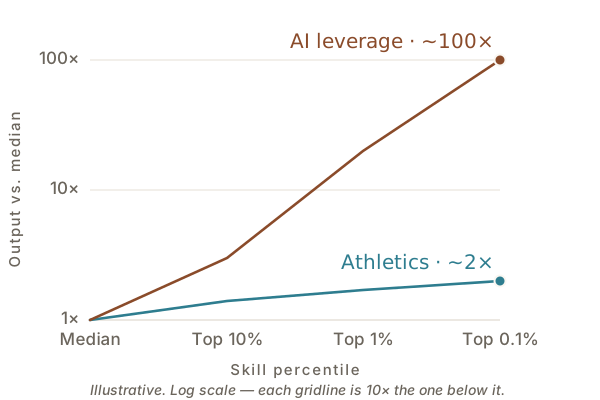
What makes this a real power law rather than just a big gap is that almost nobody is on the steep part of the curve. Building systems that stay useful across long horizons — decomposing work, keeping context, catching your own errors, knowing when to stop — is still genuinely hard. The median knowledge worker has captured close to none of this. The economy-wide numbers barely move. The distribution is not shifting; it's stretching.
And yet the gap is closing
Here's the part that surprises me.
Three years ago, this was esoteric. If you wanted an agent that could work for an hour unattended, you built the scaffolding yourself, and the knowledge lived in a few hundred people's heads and a handful of Discords. There was no way to buy it.
Now it ships. The labs have product teams whose entire job is turning last year's expert practice into this year's default behavior. Orchestration, memory, tool use, long-horizon planning — each of these was a moat and each became a feature. Whatever clever thing the top 0.1% figured out in the spring tends to be a checkbox by the fall.
You can watch the same compression between frontier and open models. It used to feel like a two or three year lead. It now feels like one or two quarters.
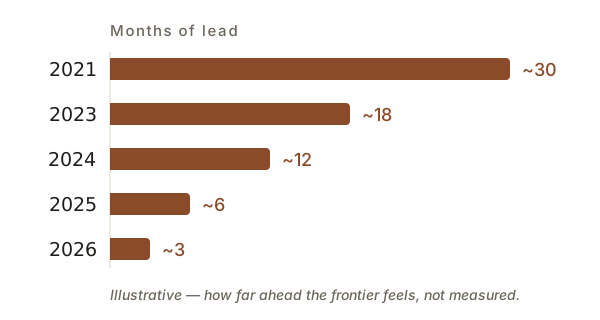
I'd put the first chart's gap at 100x and the second chart's lead at a single quarter, and I don't think those are in tension. They're measuring different things. The first is how much more you can do than the median. The second is how long it takes the median to get the tool you used to do it.
What I think this means
The instinct when you're ahead is to protect the position. That instinct is wrong here, because the position isn't defensible — whatever you've built, a product team somewhere is commoditizing it, and they're faster than you.
What compounds is not the lead. It's the rate at which you re-acquire one.
The people who look untouchable to me aren't the ones with the cleverest current setup. They're the ones who've rebuilt that setup four times in two years and expect to do it again. They treat their own tooling as disposable. They're mildly pleased, not threatened, when a lab ships something that obsoletes a month of their work, because it means they get to start from a higher floor.
An edge with a three-month half-life is still worth having. You just have to be in the habit of earning it again.